
Seven things the tradition reads, in the order it reads them, and what none of them can honestly tell you.
How to read your birth chart for love
Most guides to love in a birth chart walk through Venus, Mars, the Moon and a handful of houses. Vedic astrology reads those too. It also reads two things the Western method has no equivalent for: the Darakaraka, a planet singled out as the significator of the spouse, and the Navamsa, a whole second chart the tradition consults for marriage.
What a chart can and cannot tell you about love
It can describe how you love, what you need to feel safe with someone, what kind of partner you are drawn to, and where closeness tends to come easily or take work. It cannot name a person, a date, or whether a particular relationship will last. A reading that does any of those has stopped describing and started guessing, and no classical text supports it.
You will also need your birth time for most of what follows. The houses, the seventh lord and the Navamsa's own houses are all counted from the ascendant, which changes sign roughly every two hours. Why the minute decides it.
1. The seventh house, Kalatra Bhava
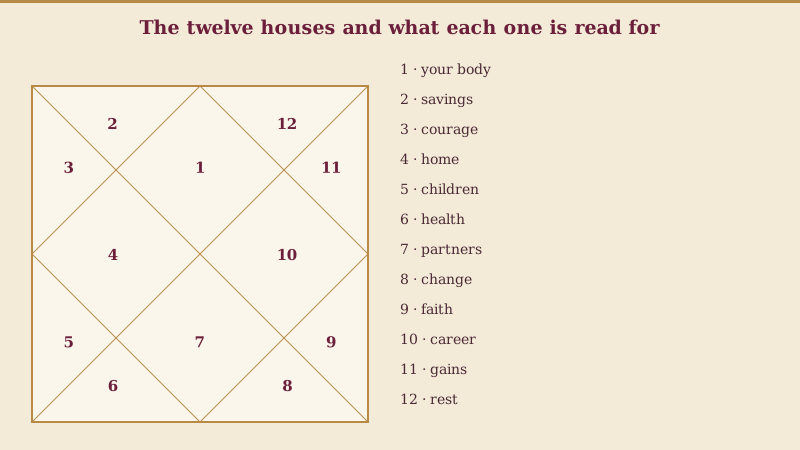
The house of the spouse and of every close one-to-one bond. The classical texts call it Kalatra or Dara Bhava. In our house reading it covers partners, marriage, and close one-on-one bonds, and it shows how you meet other people halfway and who ends up beside you.
Vedic astrology counts houses as whole signs, so the seventh house is simply the seventh sign from your ascendant. There is no cusp to calculate and no Descendant degree to worry about. The sign on it describes the manner of partnership you are drawn to.
2. The lord of the seventh
This is where most of the reading happens. The planet that rules the sign on your seventh house carries the affairs of partnership into whichever house it occupies. A seventh lord sitting in the tenth ties partnership to public life and work; in the fourth, to home and family; in the twelfth, to distance, privacy or a partner from somewhere else.
The classical rule the tradition applies, set out in Phaladeepika, is that a well-placed seventh lord with benefic support favours a steady union, and an afflicted one asks for more care. At one end of that range our reading says: “You meet the right people halfway; partners tend to be steady, and your closest bonds actually pull their weight.” At the other: “Closeness runs hot and cold; you often end up carrying more of the bond than the other person does.”
Your seventh house, its lord and where that lord sits are all in the full chart, computed from your date, time and place of birth.
See my seventh house3. Venus, the significator of love

Venus is the karaka, the natural significator, of love, pleasure and marriage, and it is read in every chart regardless of its house. At its best it brings warmth and charm, and a real gift for love, beauty, and pleasure; its shadow is the same craving for pleasure as indulgence, vanity, and clinging to comfort.
The classical texts are written in terms of husbands and wives, and they add one more planet for a woman's chart: Jupiter is read as the significator of the husband. At its best it brings wisdom, generosity, and faith that keeps growing and lifts others. We pass this on as the texts state it rather than rewriting it.

4. The Moon, and what you need to feel safe
The Moon is read for the mind and the feelings. At its best it is a feeling mind that reads moods and connects with people warmly; in shadow, the same sensitivity swinging into moodiness, clinging, and getting hurt too easily. In love it describes what you need from someone in order to feel at ease. Vedic astrology reads the Moon before the Sun, which is why two people's Moon signs are the first thing it compares.
That comparison has its own page: moon sign compatibility, read through the friendship of the two ruling planets and the distance between the signs. And your own Moon sign is probably not the one Western astrology gave you: why the sign changes.
5. The fifth and eighth houses
The fifth house covers children, creativity, learning, and romance. In love it is the house of attraction and romance before commitment: falling for someone, rather than building a life with them.
The eighth house covers change, shared money, and hidden depths. In a relationship it describes what is shared and what is kept beneath the surface, and how a couple handles upheaval together.
6. The Darakaraka
This is the first of the two things the Western method does not have. In the Jaimini system, each of the seven planets is ranked by how far it has travelled through its own sign. The one with the lowest degree becomes the Darakaraka, the significator of the spouse, and its sign and house are read for the partner's nature.
Two honest notes. Most schools rank seven planets; one school adds Rahu, and can name a different planet as Darakaraka for the same chart. We calculate it with seven. And because it depends only on degrees, a birth date usually settles it without a birth time, except when the Moon is a contender, since the Moon moves about thirteen degrees in a day.
7. The Navamsa, the chart for marriage
This is the second. Vedic astrology uses divisional charts, the vargas, each made by cutting every sign into equal parts and mapping them onto a fresh twelve-sign chart read for one subject. The Navamsa, or D9, cuts each sign into nine, and it is the chart the tradition consults for marriage.
Brihat Parashara Hora Shastra treats a conclusion drawn from the main chart alone as incomplete, and the Navamsa is the varga it leans on most. Its seventh house and the lord of that house are read for the partner, alongside the main chart rather than instead of it. The same idea runs our career reading through the D10.
Mars and Saturn
Two more planets complete the picture. Mars describes desire and how conflict is handled. At its best: drive and the nerve to act first and push things forward. In shadow: the same fire as a short fuse, anger, and burnt bridges.
Saturn describes commitment and what lasts. At its best: patience and discipline to endure, do the hard work, and last. In shadow: the same weight as fear, coldness, isolation, and expecting the worst.
Reading it in order
- Find the sign on your seventh house and the planet that rules it.
- See where that ruling planet has landed, and read the seventh's affairs into that house.
- Read Venus, and in a woman's chart Jupiter, by sign and house.
- Read the Moon for what you need to feel safe.
- Note the fifth and eighth houses for romance and for what is shared.
- Find the Darakaraka and read its sign and house for the partner.
- Check the Navamsa's seventh house and its lord, and see whether it agrees with the main chart.
Where the steps agree, the tradition treats the theme as strong. Where they pull against each other, it treats that tension as the actual content of the reading rather than a contradiction to resolve.
Mistakes to avoid
- Reading one placement as a verdict. No single factor decides anything. The tradition reads several and weighs them.
- Using your Western signs. The sidereal zodiac sits about 24 degrees from the tropical one, so most placements move back by a sign. Read the Vedic chart in its own zodiac.
- Guessing the birth time. An hour of error usually moves every house. Without a time, read the planets by sign and leave the houses alone.
- Treating the Darakaraka as a description of a specific person. It describes a quality the tradition expects in a partner, not a face.
Common questions
Which house shows marriage in a birth chart?
The seventh, which the classical texts call Kalatra or Dara Bhava, the house of the spouse and of close one-to-one partners. Vedic astrology counts it as a whole sign from the ascendant, so it needs your exact birth time. The tradition reads the sign on it, the planet that rules that sign, and where that planet has landed.
Which planet represents love in Vedic astrology?
Venus, the karaka or natural significator of love, pleasure and marriage, read in every chart wherever it sits. The classical texts are written in terms of husbands and wives, and in a woman's chart they also read Jupiter as the significator of the husband.
What is the Darakaraka?
In the Jaimini system the seven planets are ranked by how far each has travelled through its sign. The one with the lowest degree is the Darakaraka, the significator of the spouse. Most schools use seven planets; one school adds Rahu and can name a different planet. We calculate it with seven.
What does the Navamsa show about marriage?
The Navamsa, or D9, is a divisional chart made by cutting each sign into nine parts. It is the chart the tradition consults for marriage, and its seventh house and that house's lord are read for the partner. The classical texts treat a conclusion about marriage drawn from the main chart alone as incomplete.
Can my birth chart tell me who I will marry or when?
No, and a reading that names a person or a date has stopped describing and started guessing. What the chart offers is a description of how you love, what you need from a partner, and where closeness tends to come easily or take work.
Where these readings come from
7th = Kalatra/Dara Bhava (spouse and partners of every kind) BPHS/Phaladeepika; Phaladeepika: 7th lord + benefics with strength -> virtuous spouse, happy union; affliction to 7th or its lord -> discord (Saravali on strength vs. affliction).
Venus: BPHS 3 / Phaladeepika 2: Venus = love, comfort, potency; shadow = over-indulgence. Jupiter: BPHS 3: Jupiter = knowledge & happiness (sattvic guru); shadow = excess/over-optimism.
The Darakaraka follows the Jaimini system of chara karakas; the Navamsa follows the divisional charts of Brihat Parashara Hora Shastra. Positions are computed from JPL DE421 ephemeris data with the True Chitra Paksha ayanamsa. Method is on how we calculate.
The full reading puts these together for your own chart: the seventh house, Venus, the Darakaraka and the Navamsa, in plain words.
See my full Vedic readingAn honest note on what this is
Astrology here is offered for reflection and self-understanding. It is not prediction, diagnosis or advice, and no outcome is promised. Nothing on this page should be used to decide whether to be with someone. The astronomy behind it is real and calculated; what any of it means is a tradition of interpretation, presented as exactly that.